As a core sealing solution for pump equipment under harsh operating conditions, dual mechanical seals are widely used in high-temperature, high-pressure, strong-corrosion, and particle-containing medium transfer scenarios in industries such as chemical engineering, metallurgy, and papermaking, relying on their integrated modular design, dual sealing protection, and convenient installation technical advantages. Early failure (functional abnormalities such as leakage and wear occurring before reaching 50% of the designed service life) is a core technical pain point in the application of dual mechanical seals. It not only affects the continuous operation of pump units but also may trigger potential safety hazards and economic losses. Based on the statistics of 120 on-site failure cases and laboratory test data, this article systematically analyzes the core root causes of early failure of dual mechanical seals, and proposes scientifically feasible prevention measures combined with their structural characteristics and application conditions, providing professional reference for engineering and technical personnel.
The early failure of dual mechanical seals is not caused by a single factor, but by the synergistic effect of multiple links including structural design, assembly process, working condition adaptation, auxiliary system, and operation and maintenance management. By disassembling the failure cases of seals supporting chemical pumps, centrifugal pumps, pulp pumps and other equipment, the root causes can be classified into five categories. The proportion and typical characteristics of each category in the failure cases of dual mechanical seals are shown in the following table:
It can be seen from the data distribution that non-standard assembly process and defects in integrated structural design are the main inducements for the early failure of dual mechanical seals, accounting for 58% in total. For example, the dual mechanical seal used in a strong acid medium transfer pump of a chemical enterprise had local contact stress concentration on the dual seal faces due to a pre-installation positioning deviation of the integrated module exceeding 0.04mm. After 180 hours of operation, scratch wear occurred on the seal faces, leading to medium leakage, which is a typical assembly-related early failure. Another case shows that due to the defect in the pressure balance structure design of the barrier fluid chamber, the dual mechanical seal could not maintain stable pressure on both seal faces when the medium pressure fluctuated, and fatigue failure of elastic components occurred after 300 hours of operation, which also belongs to the category of early failure.
II. Precise Prevention Measures for Early Failure of Dual Mechanical Seals
To prevent the early failure of dual mechanical seals, it is necessary to base on the whole process of "design optimization - process standardization - working condition adaptation - system matching - operation and maintenance closed loop", and implement targeted control combined with their structural characteristics of integration, dual seal faces and dependence on auxiliary systems. The core measures are as follows:
(I) Optimize Integrated Structural Design and Improve Intrinsic Reliability
The structural design of dual mechanical seals needs to be optimized around three core goals: "pressure balance, precision adaptation, and fatigue resistance". Firstly, reasonably design the structure of the dual-end seal chamber to ensure that the volume of the barrier fluid chamber meets the circulation demand, and the pressure balance device can adapt to the fluctuation of medium pressure (fluctuation range ≤±0.1MPa) to avoid uneven pressure distribution on both seal faces. Secondly, strictly control the precision of the module dimension chain, control the fit gap between the integrated module and the pump shaft within 0.02-0.03mm, and the flatness error of the dual mechanical seal faces ≤0.005mm to improve the fitting precision. Thirdly, select the material of core components suitable for working conditions. The rotating and stationary rings should preferably adopt corrosion-resistant and wear-resistant combinations such as silicon carbide-silicon carbide and silicon nitride-hard alloy, and the elastic components should adopt precipitation hardening stainless steel with high temperature resistance (≤200℃) and fatigue resistance to extend the service life. Fourthly, optimize the module installation and positioning structure, and add guide positioning pins to reduce the risk of assembly positioning deviation.
(II) Standardize Assembly Process Standards and Strictly Control Installation Precision
The assembly link is the key to avoiding the early failure of dual mechanical seals. It is necessary to strictly follow the ISO 9092-2018 standard and the technical specifications of seal manufacturers to implement the whole-process precision control. Before assembly, thoroughly clean the seal faces, integrated module and pump shaft seal chamber of the dual mechanical seal to remove oil stains, iron filings and impurities. The cleanliness should reach above ISO 16232-10 Class 7. The seal faces should be wiped with absolute ethanol and air-dried naturally, and it is forbidden to touch them with hard objects. During assembly, use a dial indicator to calibrate the coaxiality between the integrated module and the pump shaft, with a deviation ≤0.03mm, and the uniformity deviation of the fitting gap of the dual mechanical seal faces ≤0.01mm. Use a torque wrench to evenly tighten the installation bolts in 3 stages, and the torque value strictly follows the technical parameters (the torque of conventional M8 bolts is controlled at 12-15N·m) to avoid module deformation caused by uneven torque. After assembly, conduct static sealing test and barrier fluid circulation test. Pass the barrier fluid with rated pressure (1.2 times the working pressure), and put it into operation only after 30 minutes of pressure maintaining without leakage and stable circulation flow (≥5L/min).
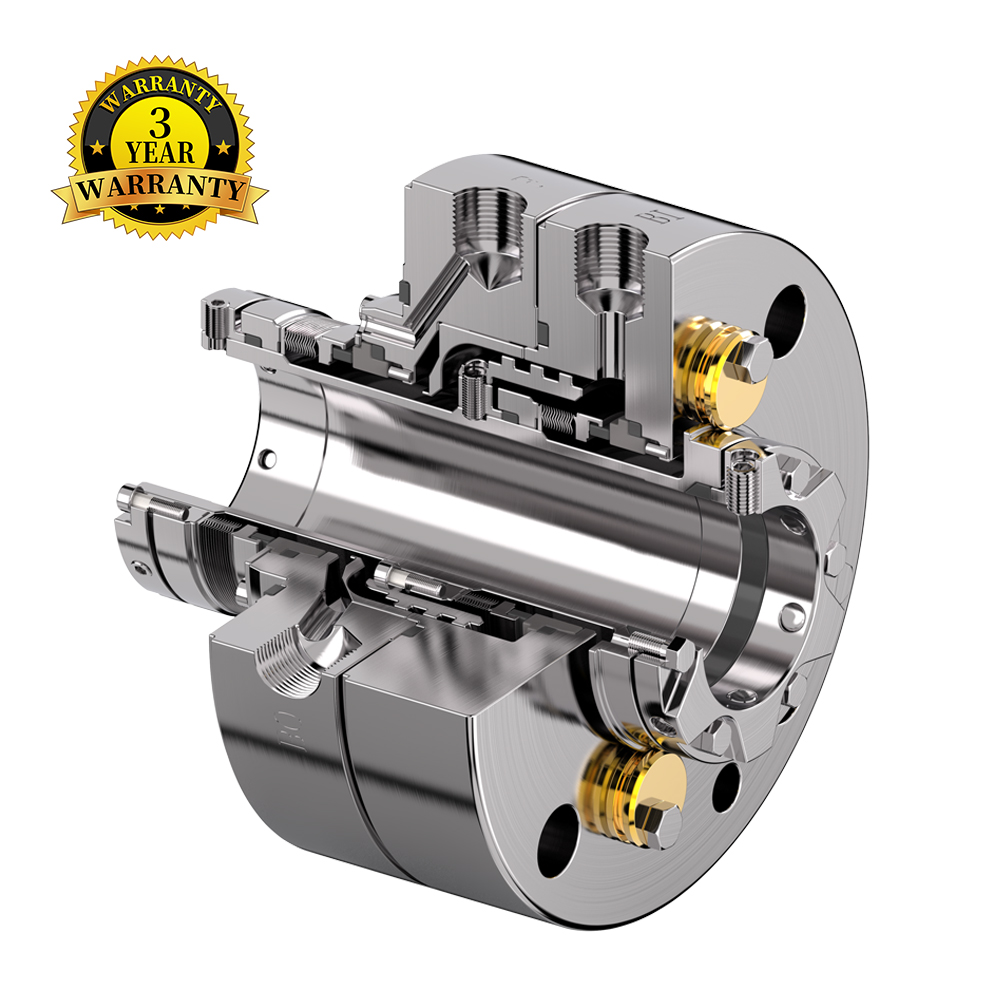
(III) Adapt to Operating Parameters and Avoid Operational Risks
The deviation of operating parameters from the adaptive range is an important external factor leading to the early failure of dual mechanical seals, and precise adaptation control is required. Firstly, clarify the rated adaptive range of dual mechanical seals. Under conventional working conditions, the temperature is controlled at -40℃~200℃ and the pressure ≤4.0MPa. For beyond this range, special customized products should be selected. Secondly, strictly control the medium characteristics. Install a high-precision filter (filter mesh size ≥80 mesh) at the pump inlet to control the solid particle content in the medium ≤50ppm, so as to avoid particle erosion on the dual mechanical seal faces. Thirdly, stabilize the operating parameters of the pump unit. The effective value of pump shaft vibration velocity ≤2.8mm/s, and the fluctuation range of medium temperature/pressure ≤±5%. Add auxiliary devices such as buffer tanks and coolers to reduce the impact of parameter fluctuation on the dual mechanical seals. Fourthly, for strong corrosion and easy crystallization media, optimize the selection of barrier fluid, and select a barrier fluid compatible with the medium and not easy to crystallize (such as ethylene glycol aqueous solution, refined mineral oil) to prevent seal failure caused by barrier fluid pollution or crystallization.
(IV) Improve Auxiliary System Configuration and Strengthen Collaborative Adaptation
The stable operation of dual mechanical seals relies on the collaborative work of supporting auxiliary systems, and it is necessary to optimize the system configuration and operation control. Firstly, configure a reliable barrier fluid circulation system, add a high-precision filter (filtration precision ≤10μm) and a flow monitoring device to ensure the smooth circulation of the barrier fluid, the flow rate is stably maintained at 5-8L/min, and the barrier fluid pressure is always 0.1-0.2MPa higher than the medium pressure. Secondly, optimize the flushing and cooling system. Configure a forced cooling jacket under high-temperature working conditions to control the temperature of the dual mechanical seal faces ≤80℃, so as to avoid seal face aging and seal ring failure caused by high temperature. Thirdly, for particle-containing media, configure an external flushing system. The flushing fluid selects a clean and compatible medium, and the flushing pressure is slightly higher than the barrier fluid pressure (0.05MPa) to prevent particles from invading the seal chamber. Fourthly, the auxiliary system pipeline adopts stainless steel material to reduce the impact of impurities falling off from pipeline corrosion on the dual mechanical seals.
(V) Establish a Closed-Loop Operation and Maintenance Mechanism to Timely Troubleshoot Hidden Dangers
Normalized operation and maintenance control is an important guarantee for preventing the early failure of dual mechanical seals. It is necessary to establish a closed-loop mechanism of "regular inspection - parameter monitoring - hidden danger investigation - spare part replacement". Daily inspect the barrier fluid level, pressure, seal face temperature and leakage of the dual mechanical seals, record the operating parameters, and immediately shut down for investigation if abnormalities are found (such as temperature ≥90℃, pressure fluctuation >±0.1MPa). Weekly check the operation status of the auxiliary system, clean the filter element, and calibrate the flow and pressure monitoring instruments. Monthly disassemble the protective end cover of the dual mechanical seals, check the wear of the seal faces and the elasticity of the seal rings, and timely polish the seal faces when slight scratches appear. Replace the barrier fluid and seal rings quarterly, and replace the dual mechanical seal faces and elastic components every 1-2 years according to the working condition wear to avoid early failure caused by aging of spare parts.
III. Conclusion
The root causes of early failure of dual mechanical seals are concentrated in five links: structural design, assembly process, working condition adaptation, auxiliary system and operation and maintenance management, among which insufficient assembly precision and structural design defects are the main inducements. By optimizing the integrated structural design of dual mechanical seals, standardizing assembly process standards, precisely adapting to operating parameters, improving auxiliary system configuration and establishing a closed-loop operation and maintenance mechanism, the probability of early failure can be effectively reduced, and its service life can be increased to more than 85% of the designed service life. In engineering applications, it is necessary to implement targeted whole-process control combined with the specific working conditions of pump equipment and the structural characteristics of dual mechanical seals, so as to give full play to its dual sealing protection advantages and ensure the continuous, safe and stable operation of pump units.


